
Quick answer: A 4x4 foot balcony can feed you year-round if you do four things: map your sun (leafy greens need about 4-6 hours, fruiting crops 6-8), use deep-enough pots (9+ inches for greens and herbs, 16-18 for tomato), grow up railings, walls and a trellis, and sow small batches every 10-14 days. Start with coriander, spinach, tomato, chilli and tulsi, then add brinjal and okra if you get 6+ hours of sun.
Key takeaways
- Sun hours decide what you can grow. Maryland Extension gives warm-season crops 6-8 hours and cool-season crops 3-5 hours of direct sun; My Mali packs list 4-6 hours for greens and 6-8 for fruiting crops.
- Depth matters more than width. UC suggests 9-12 inches for leafy greens and herbs and 16-18 inches for tomato.
- Go up before you go out: railing planters, a tiered stand or wall pockets, and a trellis.
- Sow a small pinch every 10-14 days. NC State advises radish about every two weeks and TNAU advises okra batches 2-3 weeks apart.
- Check the railing and the building rules before you hang anything heavy. Wet soil is much heavier than it looks.
Step 1: Read your sunlight before you buy a pot
Spend one day watching your balcony. Note which hours get real, direct sun on the floor or railing (bright shade does not count). Which way the balcony faces tells you most of the story. In much of India a south- or west-facing balcony gets long, strong sun and can be harsh from March to June. East-facing gets gentle morning sun, which suits greens. North-facing gets the least and suits shade-tolerant herbs. Our sunlight guide shows how to map the sun hour by hour.
Extension numbers agree on the pattern. Maryland Extension gives 6-8 hours of direct sun for warm-season crops such as tomato, pepper and eggplant, and 3-5 hours for cool-season crops such as lettuce and spinach. Iowa State says fruit-bearing crops need at least 6 hours (Iowa State guide). The pack details on each My Mali product page fit that:
| Sun zone | Hours of direct sun | Crops (pack sun hours) |
|---|---|---|
| Full sun | 6+ hours | Tomato 6-8, brinjal 6-8, okra 6-8, chilli 6 |
| Half sun | 4-6 hours | Spinach 4-6, coriander 4-6, methi 4-6, lettuce 4-6, tulsi 4-6, radish 5-6 |
| Under 4 hours | Not enough for most seeds | No My Mali seed pack lists less than 4 hours. Use that space for foliage plants or microgreens on a bright windowsill |
In the Indian summer, even sun-lovers can scorch when afternoon temperatures climb into the high 30s. A light shade net, or moving pots so they get morning sun and afternoon shade, saves plants. Containers on brick, concrete or other reflective surfaces get hotter than the air, so lift pots onto a stand where you can.
Step 2: Grow up, not out
On the ground, 4x4 feet gives you 16 square feet. The floor is only your first layer. Build in three directions:
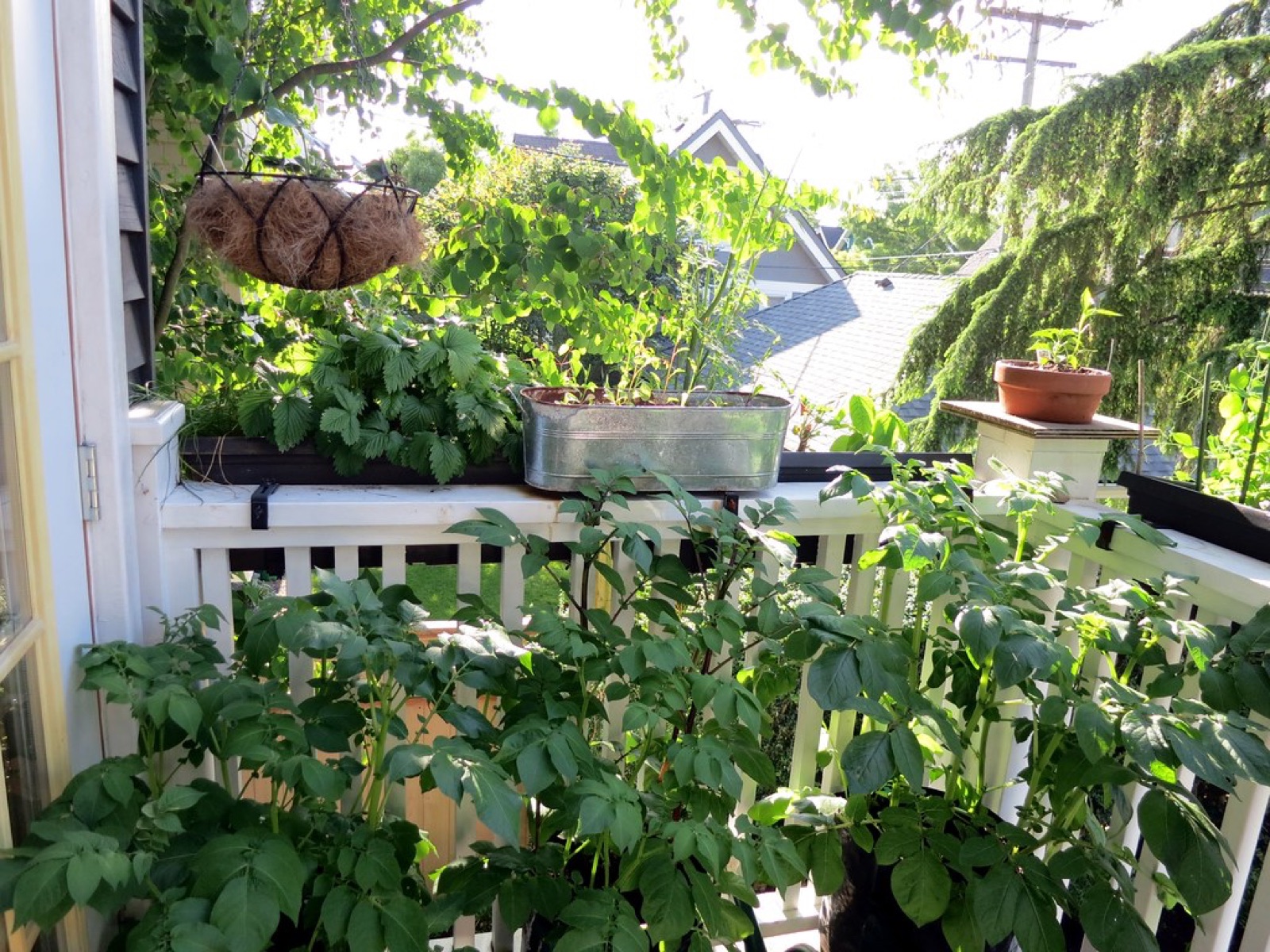
- The railing: hang rectangular railing planters over the rail for shallow-rooted greens and herbs. This is your most productive strip. Fasten them securely.
- The walls: fix a tiered plant stand or wall brackets so light reaches each pot. Fabric wall pockets work for herbs and lettuce.
- The air: run a trellis, bamboo stakes or jute string from a deep pot up to a wall hook. Climbers and tomatoes will travel upward and free the floor.
Keep the tallest, sun-hungry plants at the back or sides so they do not shade the rest, and put low herbs and greens in front. Safety first: wet soil is heavy, and a full pot on a railing can be a danger to people below. Check the building's rules and the railing's strength before you hang anything, and use the railing only for light planters. The balcony gardening for beginners guide has a full weight and wind checklist.
Step 3: Match the pot to the crop
Wrong-sized containers are the main reason balcony gardens disappoint. Roots need room, and deeper pots dry out more slowly, which helps in Indian heat. Extension sources give different depths, so here they are side by side:
| Crop group | UC Master Gardeners | Almanac chart | Our rule |
|---|---|---|---|
| Leafy greens and herbs (spinach, coriander, methi, lettuce, tulsi) | Leaf lettuce 9-12 inches; herbs at least 9 inches | 6 inches deep as a minimum | Aim for 9 inches; use 6 only for quick microgreens or methi |
| Tomato | 16-18 inches | 12+ inches (determinate), 18+ (indeterminate) | 16 inches or more with a stake or trellis |
| Chilli, brinjal, okra | - | - | Deep pot, one plant each; the brinjal pack spaces plants 45-60 cm apart |
| Curry leaf | Not listed | Not listed | Large deep pot; University of Washington suggests a gritty mix and partial shade |
Sources: UC Master Gardeners and the Almanac container chart. For curry leaf, the University of Washington Botanic Gardens guide recommends a container with a mix of soil-based compost and grit in partial shade. Give mint its own pot because it spreads. Every container needs drainage holes; waterlogged roots kill more balcony plants than any pest. Terracotta breathes but dries fast, and grow bags are light and easy to move. For the mix, see the potting mix guide.
Step 4: A crop plan that always gives you something to pick
Group crops by how fast they reward you, so there is always something ready while slower crops mature. Days are from the My Mali packs unless stated.
| Speed | Crops and days to harvest | Tip |
|---|---|---|
| Quick wins | Methi 25-35 days, radish 35-45 days, amaranth 25-40 days (TNAU) | Keeps morale high while slower crops grow. TNAU suggests thinning amaranth to 12-15 cm |
| Leafy greens | Spinach 30-40 days, lettuce 45-60 days | Harvest outer leaves and let the plant keep producing |
| Herbs | Coriander 40-50 days, tulsi 45-60 days, dill 40-50 days | Let a few coriander or dill plants flower; see the pest section |
| Fruiting | Okra 50-60 days, tomato 70-80 days, chilli 70-90 days, brinjal 75-90 days | One plant per deep pot. They yield for months |
The secret to never running out is succession sowing: instead of sowing a whole packet, sow a small pinch every 10-14 days in a fresh corner. The NC State Extension article suggests radish about every two weeks; lettuce is usually every two to three weeks because it bolts in warm weather. TNAU advises okra batches 2-3 weeks apart. Start with the crops you actually cook with, get confident and add more each season. The germination time chart and the germination secrets guide help every batch sprout. A seasonal view is in the October sowing list and the monsoon sowing guide.
Step 5: Water by finger, feed with compost
Container plants dry out faster than ground soil. Instead of a fixed schedule, test with a finger: if the top inch is dry, water until it runs from the drainage holes. In peak summer that can be once or twice a day for small pots; in winter, every second or third day. Group pots by thirst: tomato, brinjal and okra together, tougher herbs in another cluster, so one round suits each group. The watering guide has season-by-season detail.
For feeding, mix compost or vermicompost into the potting mix at planting and top up every three to four weeks as plants grow. See cocopeat vs soil vs vermicompost for how each medium holds water and food. If leaves turn pale, the yellow leaves guide sorts out the seven common causes.
Step 6: Keep pests down the gentle way
A small balcony is easy to watch. Check the undersides of leaves twice a week and catch aphids, whitefly, mealybugs and caterpillars early. Start with a firm spray of plain water and hand-picking. Our aphid, mealybug and whitefly guide covers the next steps, and the neem oil guide covers dose. Extension advice is to spray neem late in the evening or early morning, avoid open flowers and not to mix it with soap (extension Q&A).
There is a documented helper you can plant. Wisconsin Extension says hover fly larvae can eat up to 400 aphids each while developing, and that the adults need flowers for nectar and pollen. Coriander and dill are among the small-flowered herbs that attract the adults. So let a few coriander or dill plants flower near the plants that get aphids.
Copy-me layout for a sunny 4x4 balcony
If you want a plan to follow on a balcony with 6 or more hours of sun, start here and adjust once you know your light:
| Spot | What to grow | Pot | Pack data |
|---|---|---|---|
| Railing (front, most light) | Two railing planters: coriander and spinach, sown in small pinches every two weeks | Railing planters, 9 inches deep if possible | Coriander 40-50 days, 15-20 cm apart; spinach 30-40 days, 10-15 cm apart |
| Left corner | Cherry tomato and chilli, each staked | Deep pots, 16 inches or more | Tomato 70-80 days; chilli 70-90 days |
| Right corner | Brinjal and okra | Deep pots, one plant each | Brinjal 75-90 days, 45-60 cm apart; okra 50-60 days, 30-45 cm apart |
| Wall pockets or tiered stand | Tulsi, lettuce, methi | Fabric pockets or shallow pots | Tulsi 45-60 days; lettuce 45-60 days; methi 25-35 days |
| One big pot | Curry leaf (buy a young plant; seed is slow) | Large deep pot, gritty mix, partial shade | University of Washington guide |
| Windowsill | Microgreens on a tray | Shallow tray | Editorial |
That is roughly a dozen productive spots in 16 square feet: greens and herbs in weeks, vegetables in a couple of months. Add radish in gaps. Keep the soil alive with compost, sow a little and often, and the balcony will give more than you expect.
Common mistakes on a small balcony
| Mistake | What happens | Fix |
|---|---|---|
| Too many big plants in the front | Taller plants shade the greens | Tall plants at the back and sides |
| Pots too shallow for tomato | Weak plants, poor fruit | Use 16 inches or more (UC) |
| Watering by the clock | Waterlogged or dry pots | Finger test, water until it drains |
| Sowing a whole packet at once | Everything is ready the same week, then nothing | Sow a pinch every 10-14 days |
| Hanging heavy pots on the railing | Safety risk | Light planters only; check the railing and the building rules |
Conclusion
A small balcony is enough when you read your sun, use deep-enough pots, grow up and sow little and often. Begin with the crops you cook with every week, such as coriander, spinach and chilli, then add more each season from the vegetable seeds range or the herb seeds range. If a pack does not sprout after you sow as guided, the Germination Promise covers a replacement within 14 days.
Written by RISHI MISHRA
Agricultural Microbiology
- Qualification
- M.Sc. (Microbiology)
- Experience
- 15 years · Agricultural Microbiology, R&D, Quality Control, Fermentation, Biofertilizer and Biopesticide Development
- Agricultural Microbiology and Microbial Research
- Biofertilizer and Biopesticide Development
- Microbial Fermentation and Culture Handling
- Quality Control and Laboratory Management
- Agricultural Product Formulation and Evaluation
- Sustainable Agriculture and Soil Health
Rishi Mishra is an agricultural microbiology professional with 15 years of experience in microbial research, biofertilizer and biopesticide development, fermentation, and quality control. He holds an M.Sc. in Microbiology and specializes in microbial culture handling, agricultural product formulation, laboratory management, and product evaluation. His expertise focuses on developing effective microbial solutions, improving soil health, and supporting sustainable agricultural practices through research and innovation.
View all guides by RISHI MISHRA →Frequently Asked Questions
How do I make a kitchen garden on a small balcony?
Map your direct sun hours, choose pots 9 inches deep or more for greens and 16 inches for tomato, grow up with railing planters, wall pockets and a trellis, and start with coriander, spinach, tomato, chilli and tulsi. Sow small batches every 10-14 days so there is always something to pick.
What vegetables can I grow on a small balcony in India?
Leafy greens and herbs such as spinach, coriander, methi, lettuce and tulsi need about 4-6 hours of sun. Tomato, chilli, brinjal and okra need 6-8 hours. Radish is a quick root crop at 35-45 days. Choose by your sun hours first, then by what you cook.
How much sun does a balcony vegetable garden need?
Maryland Extension gives 6-8 hours of direct sun for warm-season crops like tomato and 3-5 hours for cool-season crops like lettuce and spinach. My Mali packs list 4-6 hours for greens and 6-8 hours for fruiting crops. Bright shade without direct sun is not enough for most seeds.
How deep should pots be for a balcony kitchen garden?
UC Master Gardeners suggests 9-12 inches for leaf lettuce, at least 9 for herbs and 16-18 for tomato. The Almanac chart lists 6 inches as a minimum for lettuce and herbs. Deeper pots hold moisture longer, which helps in Indian summers.
How many plants fit in a 4x4 balcony?
The layout in this guide uses about a dozen spots in 16 square feet by combining railing planters, wall pockets and a trellis. The exact number depends on sun and pot size. Spacing from the packs, such as 10-15 cm for spinach and 45-60 cm for brinjal, sets the limit.
Can I grow tomatoes on a small balcony?
Yes, if you have 6-8 hours of direct sun and a pot 16 inches deep or more with a stake or trellis. The My Mali tomato pack gives 70-80 days to harvest. Growing tomatoes upward on a trellis saves floor space for other crops.
What is succession sowing and why use it?
Succession sowing means sowing a small pinch of seed every 10-14 days instead of a whole packet at once. NC State suggests radish about every two weeks, and TNAU suggests okra batches 2-3 weeks apart. It stops everything ripening at once and keeps harvests steady.
Can I grow a kitchen garden on a north-facing balcony?
You can grow greens and herbs, but expect slower growth. North-facing balconies get the least direct sun, and no My Mali seed pack lists less than 4 hours. Measure your real direct-sun hours for a day, then choose methi, spinach, coriander or tulsi if you reach 4.
How often should I water a balcony garden?
Use the finger test instead of a schedule: water when the top inch of soil is dry, until water runs from the drainage holes. Small pots in peak summer may need water once or twice a day, and winter pots every two or three days. Group thirsty crops together.
How do I control pests on a balcony garden without chemicals?
Check leaf undersides twice a week, knock aphids off with a firm water jet and hand-pick caterpillars. If you use neem, follow the label, spray in the late evening and avoid open flowers. Letting coriander or dill flower attracts hover flies, whose larvae eat aphids.
More from the Journal
All guides → Seed Growing & Germination Guides
Petunia from Seed: A Beginner's Guide to Winter Blooms in Pots
Grow petunia from seeds in pots: when to sow in India, light, germination days, transplanting, pinching, feeding and bloom time. A simple beginner guide.
 Seed Growing & Germination Guides
 Plant Care, Pests & Fertilizing