

Table of contents
- Key Takeaways
- Cocopeat vs garden soil vs vermicompost: the short comparison
- Cocopeat: what it is and what it does in a pot
- Garden soil in pots: why it disappoints
- Vermicompost: a feed, not a whole pot
- Which one should you use? A simple decision table
- Common mistakes with these three
- A simple way to test any mix before you commit
- Benchmark ranges for a good container mix (US source)
- Conclusion
- Frequently Asked Questions
Key Takeaways
- Garden soil alone is the weakest choice for pots: Iowa State and K-State both say it compacts, drains badly and pulls away from the pot wall.
- Cocopeat holds a lot of water (Coir Board institute: about 8 times its weight; TNAU: more than 5 times for composted dust) but is low in nitrogen, so it needs feeding.
- Cocopeat batches differ. Salts (mainly potassium and sodium) vary by supplier, and no single "typical" EC figure is safe to quote.
- Vermicompost is a feed-and-structure ingredient. No extension source gives a safe maximum share in pots, and one trial lost plants at 25 percent, so start modest.
- Plain cocopeat pots dry out and run out of food. This is an editorial inference from sourced facts, not a quoted rule; plan to water and feed more often.
Cocopeat vs garden soil vs vermicompost: the short comparison
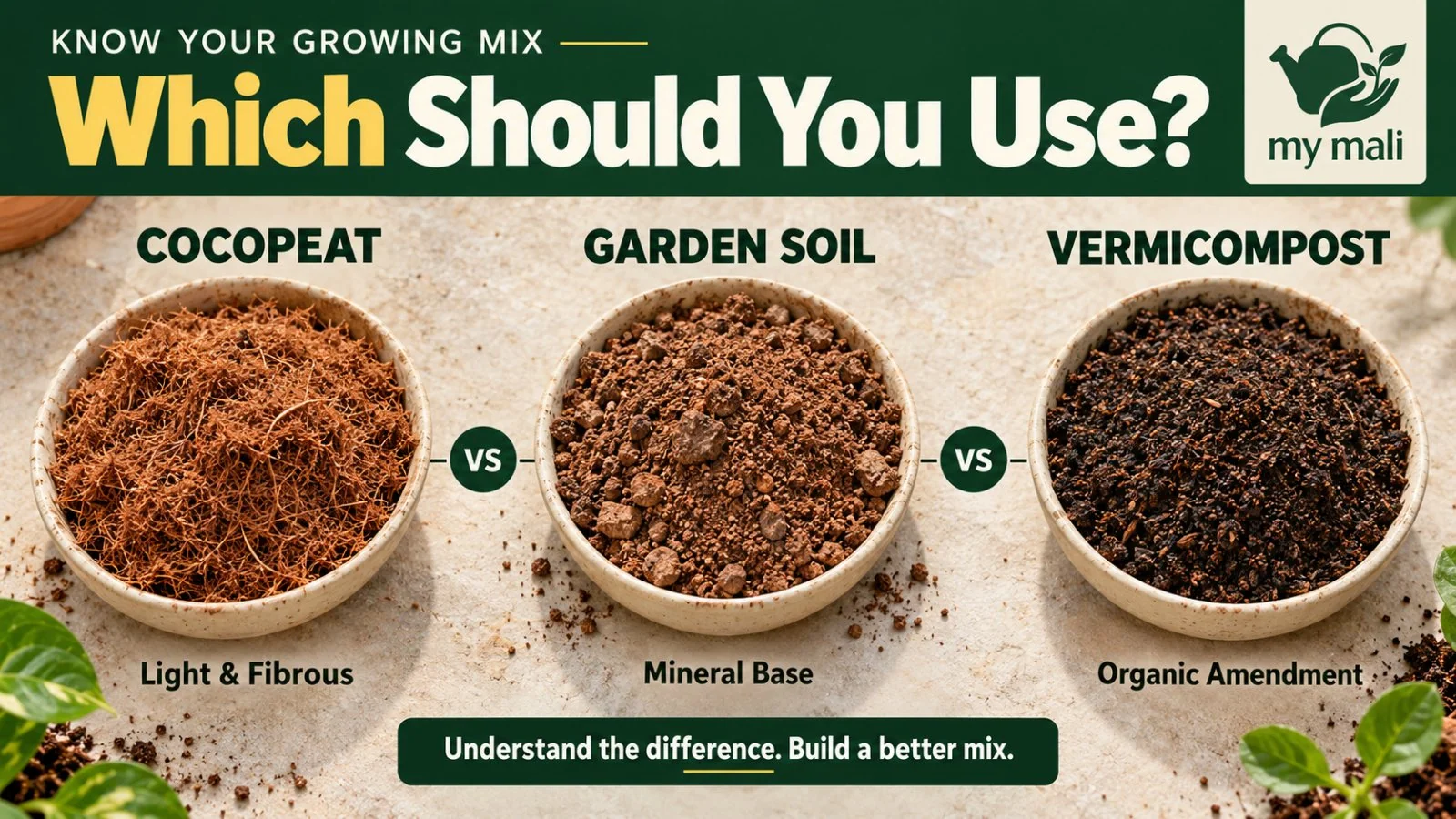
These three are not really rivals. Cocopeat and garden soil are bases: they give roots something to sit in. Vermicompost is an ingredient: it adds nutrients and organic matter. The table below only lists properties we could source. Where no reliable figure exists, the cell says so.
| Property | Cocopeat (coir pith) | Garden soil | Vermicompost |
|---|---|---|---|
| Role in a pot | Base that holds water and air | Base, but heavy; compacts in pots | Nutrient and organic-matter ingredient |
| Water holding | About 8x its weight (Coir Board institute); more than 5x for composted dust (TNAU) | Pulls away from the pot wall when dry, so water runs past (Iowa State) | Close to 9x its weight (TNAU) |
| Air and drainage | High porosity (Korean study: 83.6% total porosity for coir dust) | Compacts and drains poorly in containers (Iowa State, K-State) | No sourced figure on its own |
| Nutrients | Low. Composted pith is short of nitrogen (NCRMI) | Varies with your soil. No general figure | N 0.5-1.50%, P 0.1-0.30%, K 0.15-0.56% (TNAU) |
| pH | 5.31-6.48 in one study of coir dust | Varies. No general figure | About 7, neutral (TNAU) |
| Main risk | Salts and batch-to-batch difference; raw pith is poor | Compaction; not pasteurised, so not for seedlings (K-State) | Too much in a pot (see limits below) |
| Weight and cost comparison | No authoritative figure found | No authoritative figure found | No authoritative figure found |
The sources behind each cell are named in the sections below. A note on trust: the Indian figures come from the Coir Board's own research institute, TNAU and NCRMI. Some of the container advice comes from US extension services, which write for US weather, tap water and potting mixes. We say so each time and keep the advice cautious.
Cocopeat: what it is and what it does in a pot
Cocopeat is coir pith, the fine dust left after coconut fibre is pulled from the husk. The Coir Board's research institute (CCRI) says pith makes up about 50-70% of the husk, so it is a by-product, not a made material. Its Journal of Coconut Community paper says pith holds water at about 8 times its weight and contains 8-12% soluble tannin-like compounds, plus a lot of lignin.
TNAU gives a lower water figure: TNAU's coir pith compost page says composted coir dust holds more than 5 times its dry weight. The two numbers describe different material and methods, so do not average them. Read them as "several times its own weight", which is why cocopeat is so useful for roots that dislike drying out.
Raw cocopeat vs composted cocopeat
This is the point most blogs skip. TNAU's table shows raw pith is a poor food source: the carbon-to-nitrogen ratio is 112.1 in raw pith against 24:1 after composting, and lignin falls from 30.00% to 4.80%. In plain words, raw pith locks nitrogen up while it slowly breaks down, whereas composted pith is more balanced. NCRMI trials on pulses also found raw pith the worst medium, while a 9:1 mix of composted pith and soil did best. That was a germination trial on black gram and green gram, not a terrace-vegetable recipe, so treat it as a clue, not a ratio to copy.
Ask the seller whether the cocopeat is washed and composted. If nobody can tell you, buy a small pack first and test it before filling all your pots.
Does cocopeat feed plants?
Very little. NCRMI, a Kerala institute under the Coir Board, found that among nitrogen, phosphorus and potassium, the only major nutrient short in composted coir pith is nitrogen. Its paper also says composted pith works as a pot medium on its own, with anchorage (plants staying upright) as the one practical problem. That fits what gardeners see: cocopeat pots grow well if you feed them, and stay pale if you do not.
This is where a live microbial tonic can fit. Growth Sarthi Bio-NPK Liquid is described on its label as a living microbial tonic with Azotobacter and Azospirillum, phosphate-solubilising bacteria and potash-mobilising bacteria, each at 5x10^8 CFU/ml minimum. The label dose is 5 ml per litre of water, repeated every 10-15 days. No study in this article tested that product in cocopeat, so use it as one part of your feeding plan and watch your plants, not as a replacement for good compost.
The salt and nutrient-lock caveats
A peer-reviewed Korean study of coir dust (Shin, Son and Choi, 2012) found a mean EC of 0.563 dS/m with high variability, and said potassium and sodium were extremely high and drove the EC up. EC is a measure of dissolved salts: high EC can stress roots. The same study found the pH of coir dust ranged from 5.31 to 6.48 and that peat held 3-4 times more nutrients on its surface (CEC) than coir.
Greenhouse trade magazines add two cautions. First, cheaper coir can be salty and may need rinsing with clean water before use. Second, unbuffered coir may hold back calcium and magnesium from feed in the first weeks. These come from trade writing, not government research, and the same trade article warns that "low EC" labels from different labs are not comparable. So: rinse a new block if the water runs dark, and do not trust a "low EC" sticker as a guarantee.
Why cocopeat pots dry out fast
This one is an inference, not a quoted rule. Coir is airy and drains freely, and K-State notes that light mixes drain fast so fertiliser washes out and feeding must be more frequent. Put together, a pot that is mostly cocopeat will need steady watering and steady feeding. Our watering guide explains how to check a pot with your finger instead of a calendar.
Garden soil in pots: why it disappoints
Garden soil is fine in the ground, where earthworms and roots keep it open. In a container it behaves differently. Iowa State Extension says garden soil compacts when placed in a container, which gives poor drainage and aeration, and that it pulls away from the pot wall when dry, so water runs down the gap instead of wetting the roots. Kansas State adds that when ordinary soil is saturated, the air spaces fill with water and roots lose air.
K-State also points out that a homemade mix containing soil has not been pasteurised, so weed seeds or disease organisms can be present. It advises using such mixes for established plants, not seedlings. For seedlings, see our seed-starting mix guide.
Can I mix cocopeat with garden soil?
Yes, and many Indian gardeners do. The sources disagree on how far to go. Iowa State gives a US recipe of equal volumes of garden soil, peat moss and perlite, while noting that a commercial mix is often better. Mississippi State Extension says mixes with soil are not meant for containers at all. A fair reading: heavy soil alone is a poor choice, and a smaller share of sieved, loose soil in a mix is accepted by some extension services but is not ideal. No source gives a correct cocopeat-to-soil ratio for Indian terraces, so we do not invent one. The DIY recipe in our potting mix guide is the place to start.
Vermicompost: a feed, not a whole pot
TNAU's vermicompost page gives nutrient ranges of N 0.5-1.50%, P 0.1-0.30% and K 0.15-0.56%, a neutral pH of 7, and says castings can hold close to nine times their weight in water. That makes vermicompost a good partner for cocopeat: it adds the nutrients and microbes that cocopeat lacks.
How much vermicompost is too much?
This is where honest answers matter, because no source gives a universal cap. The numbers we found point in different directions:
| Source | What it says | What it does and does not tell you |
|---|---|---|
| TNAU vermicompost page | A recommended application rate of 15-20 percent | The page does not say weight or volume, or for which crops. It reads as a field-soil rate, not a pot-mix rate |
| Dintcheva and Tringovska, 2012 (tomato) | 10 to 50% vermicompost by volume in a peat-perlite base stimulated tomato transplant growth | Nursery transplants in a peat base, not terrace pots |
| Lazcano and Dominguez, 2010 (pansy, primula) | At 25% by volume in a peat-based mix, 20% of plants died; the authors linked this to higher EC and pH and less air space | Ornamentals in a greenhouse; worse with watering from below |
| UF/IFAS EDIS (compost in general, not vermicompost) | Some composts should be 20% or less of the mix | Different material, but a useful warning that more is not better |
So what do we do with this? Do not trust anyone who gives you one "perfect" percentage. Start with a modest share, watch how the pot drains and how the leaves look, and raise it slowly in the next pot if plants do well. If a mix turns soggy or leaf edges look burnt, you have probably gone too far. This is editorial advice built on the conflict above, not a sourced ratio.
If you want a liquid form for regular feeding, see our liquid tonics, but remember a tonic is a top-up, not a base.
Which one should you use? A simple decision table
The table below is editorial judgement built on the sourced facts above. It is not a government recommendation.
| Your situation | Better choice | Why (sourced fact behind it) |
|---|---|---|
| Light balcony, heavy pots are a problem | Cocopeat-based mix plus vermicompost as one part | Cocopeat is airy and holds water; vermicompost adds nutrients (CCRI, TNAU) |
| You travel and cannot water daily | A mix that holds water, not pure cocopeat | Mostly-cocopeat pots likely dry fast (inference); soil or compost parts can help |
| You only have garden soil | Do not fill pots with it alone; loosen it with a lighter material | Compacts and pulls away from the pot wall (Iowa State) |
| Starting seeds | A fine, clean seed mix, not garden soil | Soil mixes are not pasteurised (K-State); see the seed-mix guide |
| Using cocopeat alone | Possible, but feed it regularly | Nitrogen is short in composted pith (NCRMI) |
| Buying a cheap cocopeat block | Rinse it first and test a small batch | Cheaper coir can be salty (trade source) and batches vary (CCRI) |
Common mistakes with these three
- Filling pots with 100 percent garden soil because it is free. It compacts, and water runs past the roots.
- Using cocopeat straight from a block with no rinse and no feed. Salts and low nitrogen can both hold plants back.
- Treating "low EC" on a label as proof of quality. Test methods differ, so the numbers are not comparable.
- Adding a huge share of vermicompost because "organic is safe". One trial lost plants at 25 percent.
- Using garden-soil mix for seedlings. It is not pasteurised, so the risk of weeds and disease is higher.
- Expecting the base to feed plants for the whole season. Light mixes need more frequent feeding (K-State).
A simple way to test any mix before you commit
- Wet a handful of your mix and squeeze it. It should hold together loosely and crumble when you poke it. If it stays a dense ball, it will compact in a pot.
- Fill one test pot first and water it. Note how long water takes to drain and how quickly the top feels dry.
- If it drains slowly or stays soggy, add a lighter, airier ingredient. If it dries within a day, add something that holds water.
- Plant one cheap crop such as methi or coriander in the test pot before you fill all your containers. Our balcony kitchen garden guide lists easy starter crops.
- Watch the leaves for two to three weeks. Pale new growth points to feeding; burnt edges point to salts or too much compost.
If leaves still turn pale after you feed, read our yellow leaves guide. If you are rebuilding a mix from last season, our guide to reusing old potting soil covers what to keep and what to discard.
Benchmark ranges for a good container mix (US source)
The University of Florida (UF/IFAS) publishes desirable ranges for container substrates, written for foliage plants in the US. They are a benchmark, not a vegetable specification. The ranges are pH 5.5-7.0, EC 1-2.5 dS/m and air space of 10-20%. Most home gardeners cannot test EC, so use these as a way to understand what a good mix is aiming for: near-neutral pH, moderate salts and room for air.
Conclusion
There is no single winner. Use cocopeat or a loose mix for the base, use garden soil only as a small, sieved part if at all, add vermicompost as a modest part, and feed on a schedule. Start with one test pot, watch it for two weeks, and adjust. If you are building a full vegetable pot, follow our DIY recipe and then browse vegetable seeds for something easy to try first..
Written by RISHI MISHRA
Agricultural Microbiology
- Qualification
- M.Sc. (Microbiology)
- Experience
- 15 years · Agricultural Microbiology, R&D, Quality Control, Fermentation, Biofertilizer and Biopesticide Development
- Agricultural Microbiology and Microbial Research
- Biofertilizer and Biopesticide Development
- Microbial Fermentation and Culture Handling
- Quality Control and Laboratory Management
- Agricultural Product Formulation and Evaluation
- Sustainable Agriculture and Soil Health
Rishi Mishra is an agricultural microbiology professional with 15 years of experience in microbial research, biofertilizer and biopesticide development, fermentation, and quality control. He holds an M.Sc. in Microbiology and specializes in microbial culture handling, agricultural product formulation, laboratory management, and product evaluation. His expertise focuses on developing effective microbial solutions, improving soil health, and supporting sustainable agricultural practices through research and innovation.
View all guides by RISHI MISHRA →Frequently Asked Questions
Which is better, cocopeat or soil?
Neither wins on its own. Cocopeat drains and holds water well but has little nutrition, while garden soil compacts in pots (Iowa State, K-State). For most pots, a cocopeat-based or loosened mix with a feeding plan works better than soil alone. Choose by how often you can water and feed.
What are the disadvantages of coco peat?
Cocopeat is low in nitrogen, so plants need feeding (NCRMI). Batches vary, and some carry salts, mainly potassium and sodium (Korean study). Raw pith has a wide carbon-to-nitrogen ratio (TNAU). Pots with lots of cocopeat can also dry quickly, which is an inference from its airy nature.
Can cocopeat be used without soil?
Yes. NCRMI says composted coir pith works as a pot medium on its own, with anchorage as the only practical problem. You must feed it regularly, because composted pith is short of nitrogen. Rinse cheap blocks first, and check that the cocopeat is composted rather than raw.
Can we mix cocopeat with soil?
Yes. Many gardeners do, and extension services allow a smaller share of soil in a mix, though Mississippi State disagrees. No source gives a correct cocopeat-to-soil ratio for Indian terraces. Use loose, sieved soil, start with a small share and test one pot before filling all of them.
Can plants survive only in cocopeat?
Yes, if you feed them. Composted coir pith works as a pot medium alone (NCRMI), but nitrogen is the main nutrient it lacks. Without regular feeding, growth will slow and leaves may turn pale. Water more often too, since a mostly-cocopeat pot probably dries faster.
Is cocopeat better than garden soil?
For pots, usually yes on drainage and air, since garden soil compacts in containers (Iowa State). But cocopeat gives almost no feed, and soil can carry nutrients. Better means better for a container, not better in the ground. A mix with some compost or vermicompost beats either alone.
How much cocopeat should I mix with soil?
No reliable extension rule gives a cocopeat-to-soil ratio for Indian pots, so any exact number would be a guess. Start by loosening your soil until a squeezed handful crumbles, test one pot for two weeks, then adjust. Our potting mix guide has a full DIY recipe to follow.
How much vermicompost can I add to a pot?
There is no universal maximum. TNAU suggests 15-20 percent but does not say if that is by weight or volume. One trial helped tomato plants at 10-50 percent, while another lost 20 percent of plants at 25 percent. Start modestly and raise it slowly if plants do well.
Is vermicompost better than cocopeat?
They do different jobs. Vermicompost feeds plants (TNAU: N 0.5-1.50%, P 0.1-0.30%, K 0.15-0.56%), while cocopeat holds water and air but has little feed. Most pots do best with both: cocopeat as part of the base, vermicompost as a modest part, plus regular feeding.
Do I need to feed plants grown in cocopeat?
Yes. Composted coir pith is short of nitrogen (NCRMI), and light mixes need more frequent feeding (K-State). Growth Sarthi Bio-NPK Liquid lists a label dose of 5 ml per litre every 10-15 days, and you can feed with compost or vermicompost as well.
More from the Journal
All guides → Seed Growing & Germination Guides
Petunia from Seed: A Beginner's Guide to Winter Blooms in Pots
Grow petunia from seeds in pots: when to sow in India, light, germination days, transplanting, pinching, feeding and bloom time. A simple beginner guide.
 Seed Growing & Germination Guides
 Plant Care, Pests & Fertilizing