
Table of contents
- Key Takeaways
- How often should you water potted plants?
- The finger test: how to know when a pot needs water
- What changes how often a pot needs water
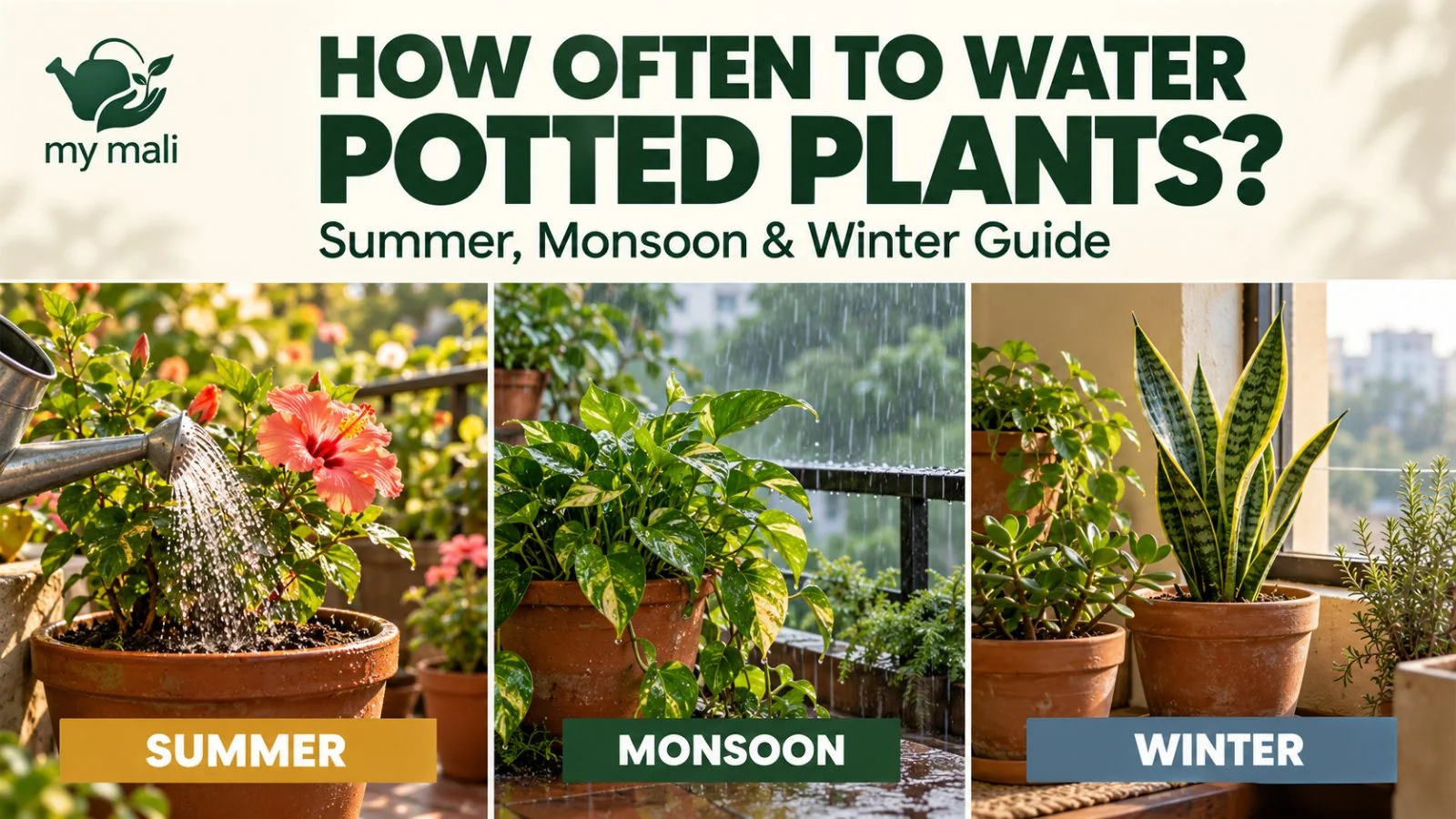
- Summer, monsoon and winter: how to adjust
- How to water the right way
- Signs of overwatering and underwatering
- Tools that help: mulch, self-watering pots and hydrogels
- A simple daily checklist
- Conclusion
- Frequently Asked Questions
Key Takeaways
- Water by checking the soil, not the clock. Check daily until you learn how fast each pot dries.
- Pot size, pot material, sun, wind, plant size and potting mix all change how often a pot needs water.
- Sources give 1 inch, 2 inches or "top feels dry" for the finger test. Start with the top inch for small pots and check deeper in big ones.
- Wilting is not a reliable sign. Plants wilt both when too dry and when kept too wet.
- We found no reliable Indian schedule by season, so this guide gives you the logic to adjust instead of invented numbers.
How often should you water potted plants?
The short answer is: it depends, so check the pot instead of following a calendar. University of Maryland Extension says to avoid watering containers on a set schedule without first checking them. It also says to check containers daily, especially in summer, until you learn how often each one dries out.
That does not mean a fixed number does not exist for your pot. It means the number changes with the weather, the plant and the pot. Most of the research below comes from US universities. It is useful, but Indian summers, monsoons and winters are different. We found no authoritative Indian source that gives a watering schedule by season, so we do not make one up. Instead, we show how to adjust.
| Source | What it says about frequency |
|---|---|
| Penn State Extension | Most container vegetable gardens need water at least once a day during hot summer months. |
| Clemson Extension | Daily or even twice-daily watering may be necessary. |
| Texas A&M | Usually once a day is adequate. If the vegetable produces a lot of foliage, twice a day may be necessary. Plants need less water during periods of slow growth. |
| Colorado State Extension | Even plastic containers may need daily or twice-daily watering as plants grow larger. |
| University of Maryland | No set schedule. Check first. Check daily until you know how each pot behaves. |
The sources disagree a little, and that is fine. A good reading is: check every day, expect to water daily in warm weather, and expect small pots in peak heat to need water more than once. Do not copy these as an Indian rule. They are US ranges for vegetable pots.
The finger test: how to know when a pot needs water
The most reliable tool you own is your finger. Push it into the soil and feel.
- Illinois Extension says that for containers, if the first inch or so of soil is dry, water.
- For houseplants, another Illinois Extension article says to test the soil with a finger to a depth of two inches.
- Oregon State Extension says to water when the top of the soil feels dry.
- Oregon State also gives a lift test for small pots: if the pot feels light, it likely needs water.
- Maryland suggests weighing your pots when they are freshly watered and when they need water, so you can judge dryness by weight later.
So what depth should you use? No source gives one universal number. Our editorial suggestion: use the top inch for small pots and window boxes, and check a little deeper (about 2 inches) in big pots and deep planters, since the top can look dry while the root zone is still wet. This is our judgement from the sources, not a rule from any one of them.
| DO NOT USE THE "1 INCH OF WATER PER WEEK" RULE You may see the rule that plants need about 1 inch of water per week. Penn State mentions 1 to 1.5 inches per week for vegetable crops in the field, in the context of drip irrigation. It is for in-ground crops, not pots. Every container source above says to check daily instead. Skip the weekly-inches rule for pots. |
|---|
What changes how often a pot needs water
Maryland Extension lists pot material, pot size, location, plant maturity, weather and plant type as the main factors. Illinois adds humidity, light, drainage and potting mix for houseplants. Here is the full picture.
| Factor | Dries faster | Dries slower | Source |
|---|---|---|---|
| Pot material | Terracotta, clay and wood. Water also evaporates through the sides. | Plastic and metal | Maryland, Clemson, Penn State |
| Pot size | Small pots | Larger pots | Maryland, Clemson, Illinois |
| Location | Full sun and breezy spots | Shade and wind-sheltered spots | Maryland |
| Plant size | Large, well-established plants whose roots fill the pot | Freshly planted pots | Maryland |
| Weather | Hot weather and dry winter air | Cool, humid weather | Maryland, Clemson |
| Potting mix | Mixes high in compost need more frequent watering | Peat moss and coir hold water better than compost | Maryland |
| Plant type | Basil, mint, parsley and cilantro need more consistent moisture | Rosemary, thyme, oregano and lavender prefer to dry out more between waterings | Maryland |
Two practical points follow. First, a small terracotta pot in afternoon sun on a windy balcony is the hardest case. Second, if you make your own mix, see our guides on the best potting mix for container vegetables and cocopeat vs soil vs vermicompost, since the mix changes how long water stays.
Summer, monsoon and winter: how to adjust
Here is the honest part. We could not find a verified Indian source that gives a watering frequency for each season. The table below is therefore our editorial logic, built from the US sources above. It tells you what to change and why, not how many days to wait.
| Season | What changes | How to adjust (editorial) |
|---|---|---|
| Summer (hot, dry) | Heat, sun and wind dry the mix fast. Small pots and big leafy plants dry quickest. | Check every day. Expect to water daily and sometimes twice on hot, dry or windy days for small pots. Water in the morning. Move pots out of the harshest afternoon sun, group pots and mulch. |
| Monsoon (humid, wet) | Air is humid, cloud cuts evaporation and rain may fall on the pot. | Check before you water, even if it rained. Make sure drainage holes are clear and water is not standing in saucers. Lift pots on pot feet or bricks. |
| Winter (cool) | Growth slows and plants use less water. In some homes the air is dry. | Check the soil, do not assume. Water less often if the pot stays damp, but do not let it dry out completely, as dry winter air also dries the mix. |
Summer
Oregon State Extension says to water in the morning, so plants can take up moisture before the peak heat, and to test moisture with your finger. It also suggests mulch and moving pots to a shadier spot during a heat wave. Oregon State and Texas A&M both mention mulch to reduce water loss. Maryland adds that you should let seeds germinate and grow for a few weeks before applying mulch, so they are not smothered, and that grouping pots slows evaporation by raising humidity around the plants.
If a plant wilts in the afternoon heat but recovers by evening, that can be heat stress and not a lack of water. Do not water on reflex. Feel the soil first. If it is dry, water.
Monsoon
We found no verified Indian source for monsoon watering. What we can say comes from general principles: Clemson warns that when the weather is cool, container plants may be subject to root rots if kept too wet. Maryland suggests propping pots a few inches above the ground on supports such as pot feet or bricks, so water drains freely. We found no source on how far rain soaks into a pot, so poke a finger in rather than assume a shower was enough. Pots under a covered balcony may not get any rain at all.
Monsoon is also a good time to sow. See our Monsoon Sowing Guide for what to plant.
Winter
Texas A&M says plants need less water during periods of slow growth. Maryland says dry winter air can also dry out potting mix. Both are true at once, so winter watering needs the finger test even more than summer. In a cool, humid room, a pot may stay damp for many days. On a dry, sunny balcony, it may dry out quickly.
How to water the right way
- Water slowly until it runs out of the drainage holes. Clemson and Maryland both say each watering should wet the whole root ball.
- Aim at the soil at the base of the plant, not at the leaves (Maryland).
- Water in the morning. This gives leaves time to dry and helps plants before the heat of the day.
- Do not fill the pot to the rim. Maryland says to leave an inch or so so water can sit and soak in.
- Use a gentle flow. A watering can with a fine rose or a soft attachment makes water flow gently, like rain.
- Empty saucers after watering so the pot is not left in water.
A big pot may need several gallons of water to be soaked, says Maryland. A small pot needs far less. Keep going until water drips from the bottom, not for a set number of seconds.
Signs of overwatering and underwatering
Many beginners read a drooping plant as thirst. Maryland says plainly that wilting is not a reliable indicator of dryness: plants can wilt if they are too dry and if they have been kept too wet. So check the soil first.
| Sign | Likely meaning | What to do |
|---|---|---|
| Soil stays wet for days, plant wilts or looks tired | Overwatering or poor drainage. Roots cannot get air. Texas A&M says plants may wilt even when enough water is present if drainage and aeration are poor. | Stop watering. Check drainage holes. Water only when the top inch is dry. |
| Leaves turn yellow from the bottom of the plant, poor colour, lack of vigour | Texas A&M links this to excess water. | Reduce watering. Improve drainage. See our guide to yellow leaves on plants for other causes. |
| Root rot | Maryland says watering too often fills air spaces with water and can lead to root rot that cannot be cured. | Prevention is the only reliable fix. Check before watering. |
| Soil pulls away from the pot edge; water runs straight through | The mix has dried out and shrunk, so water flows down the gap (Maryland, Illinois). | Stand the pot halfway in a tub of water and let it soak up from below until the surface is damp. |
| Wilting that recovers after watering | Likely too dry | Water thoroughly and check again tomorrow. |
Tools that help: mulch, self-watering pots and hydrogels
- Mulch. Maryland lists mulch to reduce evaporation, with fine pine bark, straw, shredded leaves or grass clippings as options.
- Self-watering containers. Maryland says they reduce maintenance by conserving water and nutrients. The potting mix sits on a perforated platform above a water reservoir. Illinois suggests a big or self-watering pot if you travel.
- Hydrogels. Sources disagree. Texas A&M says they absorb at least 100 times their weight in water and release it slowly. Colorado State, after field tests, says the water available to the plant is not enough to prolong the time between waterings. We would not rely on them.
- Salt build-up. Texas A&M advises flushing the mix with tap water about once a week to leach out unused fertiliser. Colorado State suggests watering so that about 10 percent of what you add drains out the bottom. We found no Indian source on borewell or RO-reject water, so we cannot give advice on that.
A simple daily checklist
- Push a finger into the soil (top inch for small pots, about two inches for big pots).
- Lift small pots. A light pot is a dry pot.
- If dry, water slowly until it drains. If damp, leave it and check tomorrow.
- Empty saucers and check drainage holes are not blocked.
- Change your routine with the weather: more checks in heat and wind, more caution in rain and cold.
- Match your pots to your light. Our sunlight guide shows how sun changes drying speed, and our balcony garden for beginners guide gives a first-month routine.
Conclusion
Watering well is a habit of checking, not a timetable. Feel the soil, water slowly until it drains, and change your routine with the weather. If you are building your care routine, look at the Plant Care range for plant-care products from My Mali.
Written by RISHI MISHRA
Agricultural Microbiology
- Qualification
- M.Sc. (Microbiology)
- Experience
- 15 years · Agricultural Microbiology, R&D, Quality Control, Fermentation, Biofertilizer and Biopesticide Development
- Agricultural Microbiology and Microbial Research
- Biofertilizer and Biopesticide Development
- Microbial Fermentation and Culture Handling
- Quality Control and Laboratory Management
- Agricultural Product Formulation and Evaluation
- Sustainable Agriculture and Soil Health
Rishi Mishra is an agricultural microbiology professional with 15 years of experience in microbial research, biofertilizer and biopesticide development, fermentation, and quality control. He holds an M.Sc. in Microbiology and specializes in microbial culture handling, agricultural product formulation, laboratory management, and product evaluation. His expertise focuses on developing effective microbial solutions, improving soil health, and supporting sustainable agricultural practices through research and innovation.
View all guides by RISHI MISHRA →Frequently Asked Questions
Do I need to water my potted plants every day?
Not always. Check them every day, but water only when the soil is dry. In hot summer weather, US extension sources say vegetable pots often need water daily, and small pots may need it twice. In cool or humid weather, pots can stay damp for days, so skip the water until the soil dries.
How often should I water potted plants in summer?
Check every day and expect to water often. US sources say daily watering is common for vegetable pots in hot weather, and twice a day may be needed for small pots, large leafy plants, or windy, sunny spots. Water in the morning. We found no Indian figure, so use the finger test.
How often should I water potted plants in winter?
Less often in most cases, but check the soil first. Plants grow slowly in cool weather and need less water, and wet soil in the cold can lead to root rot. Dry winter air can also dry the mix, so use the finger test rather than a fixed gap.
How often should I water potted plants in the monsoon?
Check before you water. High humidity and rain slow drying, and wet soil can rot roots. Keep drainage holes clear, empty saucers and lift pots on pot feet or bricks. We found no Indian monsoon schedule, and pots under a covered balcony may get no rain at all.
Can you overwater a potted plant?
Yes. Watering too often keeps the air spaces in the mix full of water and deprives roots of oxygen, which can lead to root rot that cannot be cured (Maryland Extension). Signs include yellowing from the bottom and wilting in wet soil. Check drainage and water only when the top inch is dry.
How often should I water a freshly potted plant?
Water it well straight after potting, until water drains from the bottom, then check daily. Maryland Extension says freshly planted containers dry out more slowly than pots filled with roots, so you may need to water less often at first. Use the finger test and avoid keeping the mix soggy.
How long should I water a potted plant?
Water until water runs out of the drainage holes, so the whole root ball is wet. There is no set time. A big pot can take several gallons, and a small pot much less. Pour slowly, aim at the base of the plant, and empty the saucer afterwards.
How often should I water indoor plants?
Check the soil rather than follow a schedule. Illinois Extension suggests testing houseplants with a finger to a depth of 2 inches and watering if it is dry. Type of plant, light, temperature, humidity, pot size and mix all change the gap, so there is no single answer.
Does pot material change how often I water?
Yes. Plastic and metal pots hold moisture longer than terracotta, clay or wood, which let water evaporate through the sides. Small pots dry faster than large ones. A small terracotta pot in sun and wind will need water most often, so check it daily.
How do I know if my potted plant needs water?
Push a finger into the soil. If the top inch or so feels dry, it needs water. Lifting a small pot also helps, since a light pot is dry. Do not rely on wilting alone, because plants wilt when too dry and when too wet.
More from the Journal
All guides → Seed Growing & Germination Guides
Petunia from Seed: A Beginner's Guide to Winter Blooms in Pots
Grow petunia from seeds in pots: when to sow in India, light, germination days, transplanting, pinching, feeding and bloom time. A simple beginner guide.
 Seed Growing & Germination Guides
 Plant Care, Pests & Fertilizing